
Resume Tailoring: How to Tailor Your Resume to a Job Description
Most job seekers send the same resume to every company. It's tempting — you spent hours crafting it, it looks good, and customizing it for each posting sounds exhausting.
But here's the problem: recruiters can tell. ATS systems can tell even faster.
A generic resume that doesn't mirror the language in the job description gets filtered out before a human ever reads it. That's what resume tailoring fixes. Learning how to tailor your resume doesn't mean rewriting it from scratch — a tailored resume just means making smart, targeted edits, and once you have a system, it takes less than 10 minutes.
Why resume tailoring works
Every job description is a cheat sheet. The recruiter tells you exactly what they want: the skills, tools, responsibilities, and even the specific words they use to describe the role. When your resume echoes that language, two things happen.
First, the ATS parser finds the keywords it's looking for and ranks you higher. Second, the recruiter's eye catches familiar phrases and stops scanning — in a good way.
Generic resumes fail because they're written for a category of job, not a specific one. A resume that says "managed cross-functional teams" when the job posting says "led Agile sprints across engineering and design" is leaving points on the table.
The 4-part tailoring system
1. Pull out the must-have keywords
Read the job description once quickly to get a feel for the role. Then read it again slowly and highlight:
- Hard skills (specific tools, languages, platforms — Python, Salesforce, Figma)
- Soft skills that appear more than once (communication shows up once; leadership shows up four times — that's a signal)
- Action verbs they use repeatedly (build, scale, own, drive)
- The job title itself and any close variants
These are your priority keywords. If they're not in your resume, they need to be.
2. Compare against your current resume
Go section by section and ask: does my resume use the same language? Not synonyms — the same words.
ATS systems don't always understand that "UI/UX design" and "user experience design" mean the same thing. Some do. Many don't. When in doubt, use their exact phrasing.
This is where most people underestimate the work. They think "I have this skill, so I'm fine." But if the job says "data analysis using SQL" and your resume says "worked with databases," you've missed the keyword.
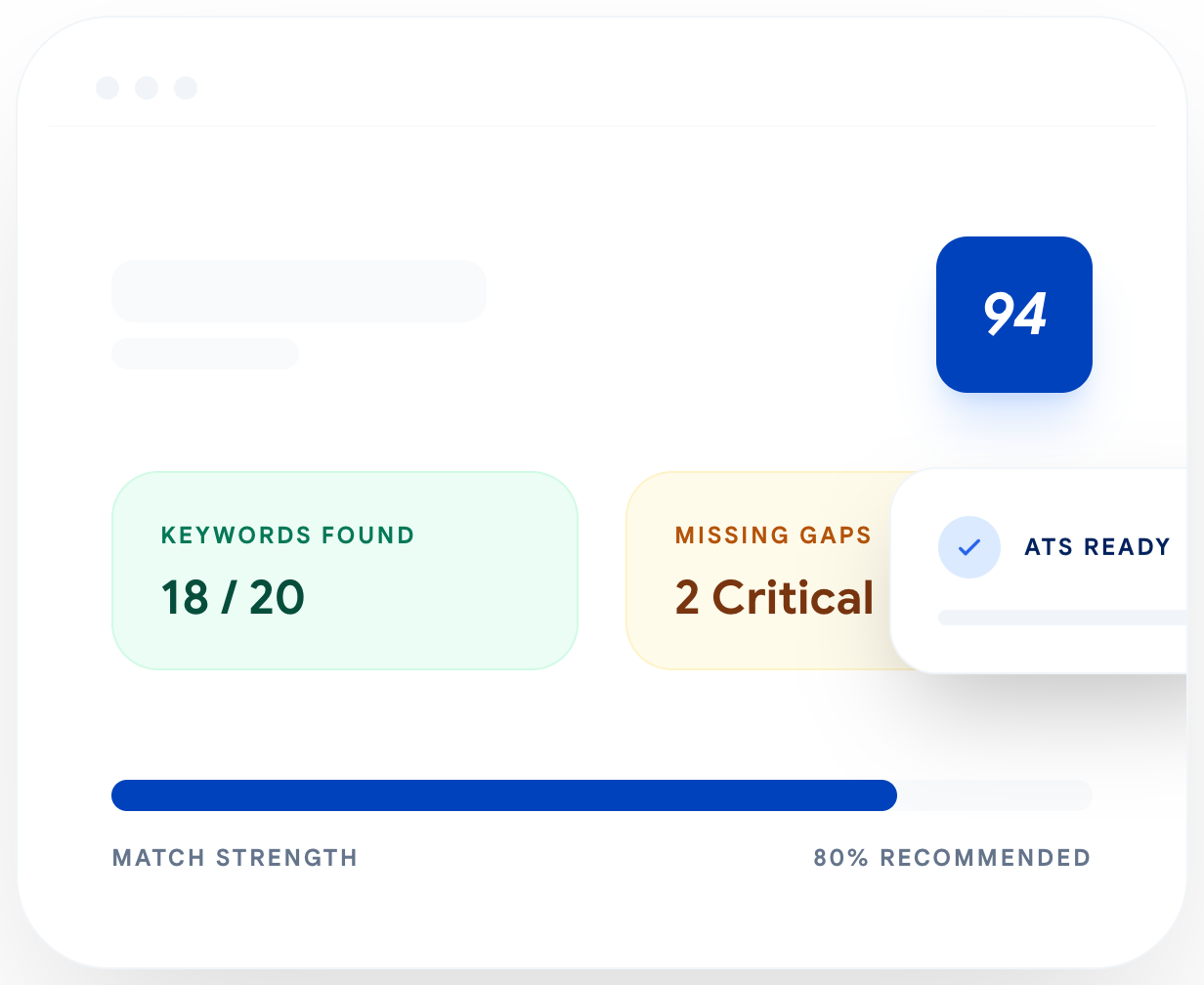
Use a resume keyword matcher to automate this comparison. Paste your resume and the job description and you'll instantly see which keywords are missing, which are present, and what your match score is.
3. Rewrite your bullet points around their priorities
You don't need to rewrite everything — just the bullets that are close but not quite right.
The goal is to move their top priorities to the front. If they list "cross-functional collaboration" five times in the posting, your most relevant collaboration experience should be the first or second bullet under your most recent role, not buried at the bottom.
A practical rewrite framework: Result + Action + Context + Keywords
Instead of:
"Worked with designers and engineers to ship new features"
Try:
"Shipped 12 product features per quarter by coordinating cross-functional sprints between design, engineering, and QA"
Same experience, more specific, uses their language, and leads with a measurable result.
4. Update your summary for the specific role
Your professional summary at the top is prime real estate. Most people write one generic summary and never touch it.
Write a 2–3 sentence summary that:
- Names the specific role or type of role you're targeting
- Calls out 2–3 of their highest-priority keywords
- Gives one concrete proof point (years of experience, a specific achievement, a relevant industry)
Example: if you're applying for a Senior Product Manager role at a fintech company, your summary shouldn't say "results-driven product professional with a passion for building great products." It should say something like: "Product manager with 6 years building B2B SaaS products. Led 0-to-1 launches at two Series B fintech startups, with a focus on growth loops and enterprise sales enablement."
What not to change
A few things are not worth touching every time:
Your work history dates and titles. These are facts. Don't adjust them per application.
Your education section. Unless a posting specifically asks for a degree or certification, this rarely changes.
Skills you don't actually have. Adding keywords you can't back up in an interview is a short-term play with a bad ending. Only tailor with skills that are legitimately yours.
The faster way to do this
Manually comparing a job description to your resume and rewriting bullet points takes time. For active job seekers applying to 10–20 roles a week, that's unsustainable.
Answerly's resume tailoring tool lets you paste a job description alongside your resume and get an instant keyword match score, see which specific phrases are missing, and understand how closely your experience aligns with each requirement. You can make targeted edits and re-check your score in real time.
It won't write your resume for you — that would be missing the point. But it removes the guesswork and cuts the tailoring time from 30 minutes to under 10.
The one thing most people skip
After tailoring, read your resume out loud.
Not to proofread — to check whether it still sounds like you. Keyword-stuffed resumes feel robotic and recruiters notice. The goal is a resume that reads naturally and happens to contain exactly the right language, not a resume that sounds like it was assembled from a job posting.
If something sounds forced, rewrite it until it doesn't.
How many applications are worth a tailored resume?
All of them, if you're being honest about fit. But not all roles deserve equal effort — and you don't need to tailor resume content from scratch for every single one.
Tier 1 (dream jobs, referrals, warm leads): full tailoring, custom summary, rewritten bullets.
Tier 2 (good fit, applied cold): keyword alignment, updated summary.
Tier 3 (long shots, exploratory): basic keyword check, send your standard resume.
Most job seekers get this backwards — they spend the most time on long shots and rush through applications where they actually have a shot.
Start with your base resume
Before you tailor anything, you need a clean base resume that's well-formatted and ATS-compatible. If you're not sure whether your current resume even gets past the parser, check your ATS score first. It's free and takes about 30 seconds.
Once you know your baseline, the tailoring process becomes much more targeted.